
"Philippine arabica"
55 article(s) found

Introduction of Indonesian Coffee planting method, quality characteristics, Taste, Flavor description, Taste and Manor
Indonesian coffee bean flavor description introduces that the Tanatolaya people on the island of Sulawesi have grown exquisite Toraya coffee beans. This coffee is a multidimensional coffee grown in the northern plateau of South Sulawesi. Its ripe fruit is distinguished by its rich flavor and the color of dark chocolate. The Torayans produce two kinds of coffee beans, Arabica and Robusta. Toraya coffee has a rich mu.

Description of baking degree and flavor of Pacamara beans in Guatemala introduction to the characteristics of varieties
Guatemala Pacamara bean roasting degree flavor description taste variety characteristics Antigua coffee can be traced back to the Mayan civilization. Due to the eruption of the volcano, the soil here is more nutritious, and the sufficient sunlight and moisture also make the coffee produced excellent quality. Most importantly, the residents here insist on growing Arabica bourbon, albeit with a small yield.

Coffee beans can be planted there in China. Environmental characteristics, varieties and taste manor.
The main producing areas are Sumatra, Guawa and Sulawesi. 90% of them are Robbas species, which can be rated as the first in the world in quality. Sumatra is best known for its rich, catchy and upscale Mantenin. In addition, Mount Jiayu is also produced in the north of the island, while Arabica in Guawa has a good sour taste, especially loved by the Dutch. What Sulawesi produces is a large-grained Carlo.

Distribution of planting and production zones of high-quality coffee in the world
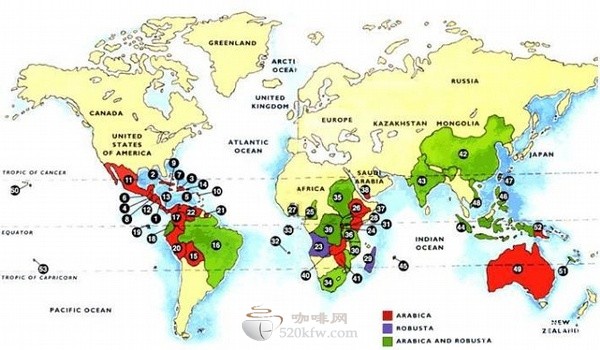
The coffee belt (coffee production zone) ranges from 25 degrees north latitude to 30 degrees south latitude, including many countries in Central, West Africa, the Middle East and South Asia, the Pacific, Latin America and the Caribbean.

Glamour chain coffee shop recommendation
The comfort of the coffee shop has been greatly improved, and the food eaten has been upgraded from bread and cake to home made meals, becoming the third place outside of work and home.

Introduction of coffee countries in the world: an introduction to the development history and characteristics of coffee in different regions of different countries
Coffee production belt: the coffee belt (coffee production zone) ranges from 25 degrees north latitude to 30 degrees south latitude, including many countries in Central, West Africa, the Middle East and South Asia, the Pacific, Latin America and the Caribbean. The reason why coffee cultivation is concentrated in this area is due to the limitation of temperature. Coffee trees are very vulnerable to frost and are not suitable for north or south latitudes.

Boutique Coffee introduction to 53 Coffee producing areas around the World
forty-four. In 1715, the first coffee trees (about 40) were transported from the Yemeni port of Moka to La Runion, but unfortunately only two survived. By 1719, coffee plantations had flourished and the first beans were sold. Over the next few years, the government took a hard measure: the islanders, black and white, had to plant 100 coffee trees a year.

The most detailed introduction of coffee varieties in history
There are many kinds of coffee, and the products from different places have their own unique characteristics, which are generally distinguished by color, aroma, taste, acidity and wine taste. Extreme characteristics are not the only condition for becoming a famous coffee. Extreme strength can be both advantages and disadvantages, depending on personal preference and acceptance, depending on the balanced distribution of color and aroma, and can highlight the characteristics of a certain aspect. In coffee
Introduction of Coffee from 53 Coffee producers in the World (5)
forty-one. Coffee cultivation in Zimbabwe (Zimbabwe) began relatively recently, in the 1960s, when farmers in southern Africa set up coffee plantations. Coffee cultivation in Zimbabwe is mainly concentrated in the eastern highlands near Mozambique, mainly by the Chimanimani mountains and northward Nyanga (Ny).

La Minita Flower God, La Tisa Manor, Farahan Plateau, Guatemala
To really understand the flavor changes and product differences of coffee beans is to understand the production place and growers, different manors with different flavors, or different flavors on different hills of the same manor, and the story behind each coffee bean is what the fragrance wants to know. It can be traced back to which plot of the estate where the beans came from, or which cooperative or which farmer, chasing the flavor of the region. To

What are the famous manors in Guatemala? Visit Guatemala producing areas and manors and eight major producing areas
To really understand the flavor changes and product differences of coffee beans is to understand the production place and growers, different manors with different flavors, or different flavors on different hills of the same manor, and the story behind each coffee bean is what the fragrance wants to know. It can be traced back to which plot of the estate where the beans came from, or which cooperative or which farmer, chasing the flavor of the region. To

World Map of Coffee beans-- introduction of 53 coffee producing areas in the world
twenty-one. Venezuela oil was once considered the main export of Venezuela (Venezuela). Although coffee trees were introduced from Martinique in 1730 and Venezuela, coffee production was almost abandoned at the height of the oil industry. Recently, coffee plantations have begun to recover, with original Tipica and bourbon coffee trees and new plantations
Introduction of Coffee from 53 Coffee producing areas in the World
one. Costa Rican coffee has full grains, ideal acidity and unique strong aroma. Tarrazu of Costa Rica is one of the major coffee producing areas in the world. Costa Rica, with its fertile volcanic soil and good drainage, is the first country in Central America to grow coffee and bananas for commercial value. Coffee and fragrance
Coffee beans from 53 producing areas-enough to make you memorable
one. Costa Rican coffee has full grains, ideal acidity and unique strong aroma. Tarrazu of Costa Rica is one of the major coffee producing areas in the world. Costa Rica, with its fertile volcanic soil and good drainage, is the first country in Central America to grow coffee and bananas for commercial value. Coffee and fragrance
Have a comprehensive understanding of coffee
Legend of Coffee the person who first discovered coffee: a shepherd in Ethiopia, in the fifth and sixth centuries AD. It is said that Niankadi, a shepherd with talent as a poet, herded sheep on the mountain paths of the Ethiopian plateau every day. He liked to drive the sheep home with a shrill flute, but one day the flute sounded again and there was no sign of the sheep. He looked everywhere. Find sheep